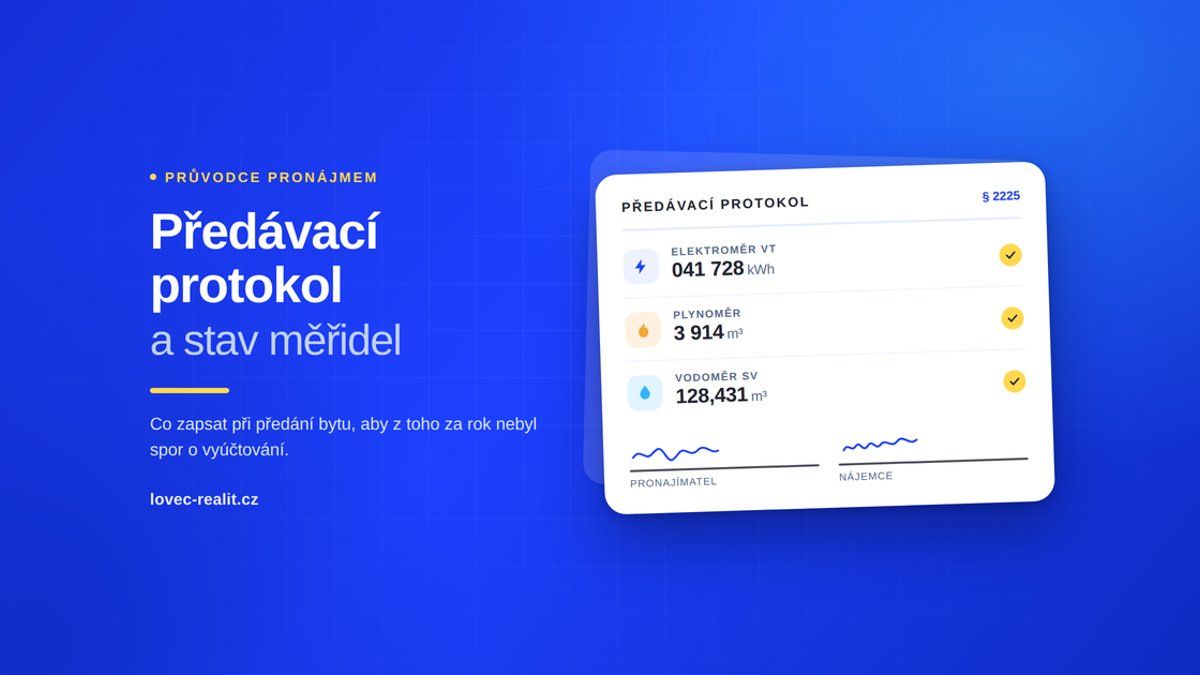
Czech law orders nobody to draw up a handover protocol. It is still the only piece of paper that, a year or three years later, shows what condition the flat was in and what numbers were on the electricity, gas and water meters. Without it, both sides end up arguing with phone photos and the other party's memory.
What the law says about the handover protocol
The Civil Code does not require the protocol, but it builds on it. Under § 2225(1), if a record describing the item was made when it was handed over to the tenant, that record is also taken into account when the item is handed back to the landlord. The protocol written at the start of the tenancy is therefore the yardstick against which the flat is measured at the end.
The other half of the rule sits in § 2293(1): the tenant returns the flat in the condition in which it was received, ordinary wear and tear from ordinary use excepted. Disputes are almost never about whether that rule applies. They are about what the starting condition actually was.
Under § 2292 the flat is handed over the moment the landlord receives the keys. The meter readings therefore belong to that same day, not to a week earlier just to get it over with.
Meter readings: what exactly to copy down
The number on the display alone is not enough. For the reading to be usable both by the energy supplier and in a possible dispute, it has to be clear which device it came from.
| Meter | What to put in the protocol |
|---|---|
| Electricity meter | serial number, reading in kWh, on a dual-tariff rate both the high and the low tariff separately, EAN of the supply point, rating and number of phases of the main breaker |
| Gas meter | serial number, reading in m3, EIC code of the supply point |
| Cold and hot water meters | each meter separately: serial number, reading in m3 including the decimals, seal intact or not |
| Heat meter or radiator allocators | device number and reading for every radiator, including how many radiators there are |
Water meters are where decimals go wrong most often. The black fields on the dial are whole cubic metres, the red ones are decimals. Write the number down exactly as it appears and attach a photo.
How to record a reading that holds up
- Photograph the display and the serial number in one shot. A photo of the display alone does not prove which device it came from.
- Add the date to the photo. A picture with no date and no signatures does not prove when the reading was taken.
- Both parties sign, including any addendum added later.
- Each party keeps its own signed original, ideally a scan too.
- Check the seals. A damaged seal is a separate problem, far better described at handover than at billing time.
- Record the number of keys, fobs and garage remotes handed over. The keys decide the day on which the flat counts as returned.
Meter verification: when a reading can be challenged
Regulated meters have a limited verification validity. Once it expires, the measured values can be contested, so it pays to note in the protocol the verification year stamped on the seal or the label.
| Meter | Verification validity |
|---|---|
| Mechanical water meter, cold and hot water | 5 years |
| Static water meter, ultrasonic or magnetic-inductive | 8 years, since 1 July 2024 |
| Heat meter | 4 years |
| Diaphragm gas meter up to size G6 | 10 years |
| Static electricity meter, direct connection | 12 years |
| Induction electricity meter made after 1 January 1990, direct connection | 16 years |
The electricity and gas meters usually belong neither to the landlord nor to the tenant but to the distribution company, so an expired verification is reported to the distributor rather than fixed privately. Water meters inside the flat are normally the owner's or the owners' association's business.
Transferring the supply point to the new customer
The reading from the protocol is the input for the transfer. To transfer a supply point, ČEZ Distribuce asks for the new customer's name and identification details, the rating of the main breaker, the number of phases, the distribution rate, the EAN of the supply point, the current electricity meter reading, on a dual-tariff rate both the high and the low tariff, and the handover protocol as proof of handover. The simplest route is through your chosen supplier, who arranges the transfer with the distributor under a power of attorney.
The practical consequence: without a signed protocol carrying the reading, the transfer either drags on or is done on an estimate, and the difference lands on whoever cannot document their number.
When the reading turns into a service bill
Billing for services connected with the use of a flat is governed by Act No. 67/2013 Coll., and it contains three deadlines worth knowing on both sides.
- The service provider must deliver the billing within 4 months of the end of the billing period.
- An overpayment or an underpayment is settled within 4 months of the billing being delivered.
- Objections are raised within 30 days of receiving the billing or the supporting documents, and the provider deals with them within 30 days as well. Missing that window weakens your position, because the billing is then presumed correct.
For late delivery of the billing or of the supporting documents the law provides for a penalty of 50 CZK for every started day of delay. It is not automatic, courts look at the circumstances, but it works as an argument.
The deposit and unpaid energy bills
Under § 2254(1) the deposit and any contractual penalty together may not exceed three times the monthly rent. The landlord may use the deposit for debts arising from the tenancy, including an unpaid service bill, but has to evidence that debt with the billing. Holding the whole deposit back because the billing has not arrived yet is supported neither by the protocol nor by the law: until the billing exists, the claim is not proven.
That is why the protocol should also state how the parties agreed to settle the deposit and where the balance goes. A bank account number in the protocol saves two months of arguing.
Checklist before signing
- Date and time of handover, address and identification of the flat.
- Readings of every meter with serial numbers and photos.
- Number of keys, fobs and remotes handed over.
- Description of rooms, floors, windows and fixtures, including defects that already exist.
- List of the furnishings that stay in the flat, with their condition and the brand of any appliances.
- Contact details and the bank account for settling the deposit.
- Signatures of both parties and one original for each of them.
The protocol is written twice: when moving in and when moving out. The first one matters more, because it sets the baseline. If you are still choosing a place, browse the apartments for rent and have the protocol ready before you get the keys.

